
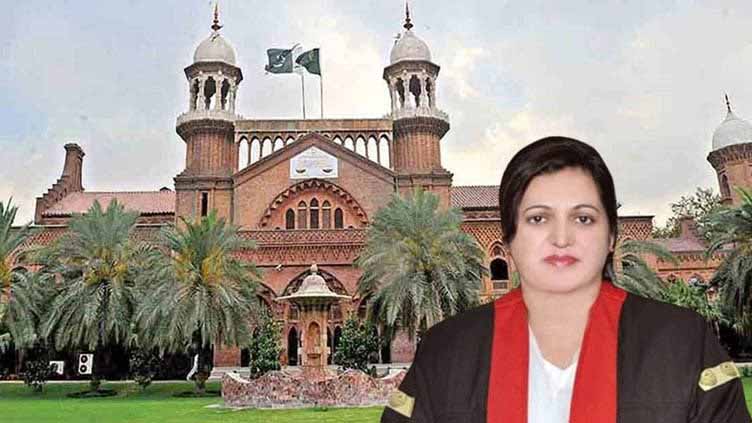
LAHORE (Speaks Pakistan) – After objections were eliminated, the Lahore High Court (LHC) forwarded 18 additional petitions filed against acts taken under the Punjab Property Ownership Act to a full bench on Wednesday, issuing a stay order while requesting the whole record of proceedings conducted by the committees.
Chief Justice of the LHC, Aalia Neelum, heard the applications, including Abu Bakar’s. Advocate Shahid Rana and other attorneys appeared for the petitioners.
During the hearing, Chief Justice Justice Aalia Neelum noted that tribunals were intended to be constituted under the Act with possession powers, but the notification for the tribunals was published two and a half months later. She questioned under what legislation the committees continued to transfer up possession throughout this time.
The Chief Justice questioned Assistant Advocate General Waqas Umar about the implementation of the relevant provision of the Act, which states that if a matter is pending before a civil court, the deputy commissioner must file an application, and the court is required to transfer the case to the tribunal.
She also commented on how possession was being transferred verbally without writing directives, questioning if such verbal instructions would be permissible even if delivered by a court without a formal order.
The Chief Justice questioned whether the tribunals had truly begun operations, pointing out that there was no personnel present and no indication of where the tribunals would be located. She inquired whether this was an overreach of authority.
The court emphasized that the statute does not reference committees having the authority to hand up possession, and that under the Act, possession may only be ordered when the tribunal has completed its hearings. The Chief Justice questioned under what legislation the committees were asking the police to seize possession.
The petitioner’s counsel informed the court that the Deputy Commissioner of Sheikhupura had orally ordered the transfer of possession. The Chief Justice stated that all petitions include significant charges, and that the court is reviewing each case to see what the law truly provides and how it is being applied in practice.
During the hearing of another petition, it was revealed that, despite the fact that the case was still pending before the High Court, the deputy commissioner took possession. The Chief Justice noted that this constituted a breach of the High Court’s directives.
The government counsel contended that the Act’s rules had yet to be drafted. In response, the Chief Justice questioned how measures could be conducted in the absence of guidelines, as well as how an affected party might appeal a judgment if the deputy commissioner had not issued a formal order. The court noted that a statute cannot be regarded incomplete; it is either complete or not.
Subsequently, the LHC sought a detailed record of all committee acts and sent all cases to a full bench for further hearing.

